What a week! As soon as I got back from a Peace Corps
meeting in Ocotal last Thursday, I was non-stop on the go up until this
morning! Ocotal was a blast, like usual, with the other awesome volunteers, an
intense trivia night and lots of story telling with great new friends.
I got back to Jalapa early Thursday afternoon and before I
had time to make a quick bite to eat after a really fast workout (gotta stick
to my exercise program!), the director of MINSA (also my housemate; she is living
with me and the professor. We are also renting out one more room to an
architect that is helping with the construction at the Centro; very nice and
quiet lady) took me and one of the physical therapists to one of the local
lodging areas “El Pantano”. We were setting up to have the welcome party for a
group of nursing students from the states called ISLA who were going to be
arriving shortly.
ISLA is an organization based out of Minnesota that seeks to empower Latin American communities to become more resourceful and self-sustaining, aided in part by ISLA's medical, education and construction programs.
I asked the doctor what I would be doing for the group and
she said if I could just translate what she was going to say to the group and
in turn translate their questions for her. When the group showed up, I was so
excited to see more gringos! The group consisted of about 12 students, their
instructor who is also a Nurse Practitioner, a Criminal Justice professor, all from Idaho, and
the two ISLA representatives from Minnesota. I was a surprise to them since they were only
expecting Nica translators but were very excited that I would be assisting thru
the week.
After a quick snack for dinner, the doctor, PT and I said
our goodbyes to the group and went home to start preparing for the busy week
ahead.
Friday
I met up with the group at the Centro where they
presented the doctor with a TON of new medical supplies for the hospital.
Stethoscopes, blood pressure cuffs, scrubs, catheters, just a huge abundance of
EVERYTHING. I was in such awe of how many things they all brought and I know
that the doctor and staff were very appreciative. The group was also lucky
enough to come to Jalapa during the time of the 37th anniversary of
the instituto (high school).
They got to meet my site mate, a TEFL volunteer (Teaching
English as a Foreign Language) and we got to partake in the parade to the
school and watch some of the festivities that they presented to the school’s students
and faculty. Some of the group even got to meet the Profe I live with! She was
very excited to meet them and introduced me to the group as her “hija”
(daughter). Another Nica madre!
After lunch, the group went back to the Centro and went to
some houses that have history with Dengue and Malaria larvae with some
epidemiologists so that the students could see what their job is and what to
look for. It was very educational and a chance for the students to see what
“typical” Nica houses look like.
Saturday
I met the group for breakfast (which they treated
all week for me, lunch, too! I was completely grateful and was NOT expecting
it!). I then went with the Criminal Justice professor to the women’s clinic,
Oyanka, to translate some interviews with women. She is doing a study to
compare the reasons why women come to clinics in Nicaragua and why they go in
the states and what services are offered.
We heard 3 stories and they all were different but extremely impactful.
Nicaraguan women go through so much in their lives and yet they continue to
raise their families and are some of the strongest women I’ve met.
After lunch, groups were broken up and some went to the
elementary schools to read books, some people went to the high school and
others went to a neighborhood above the lodge to do some basic eye exams for
reading glasses and take blood pressure and check the heart rate to some of the
locals.
Sunday
After breakfast a group of the students and I with
another translator went to the high school to give more eye exams and blood
pressure/heart rate checks to some of the professors and adult students who
have weekend classes. . On the way there, a burst of cuteness decided to cross
our paths in the form of baby piglets! Little snorts and all!
It was a great turn out and I actually got to meet and talk
with some of the professors who know my site mate. I am looking forward to sit
down with them and the principal and finally get a schedule to start giving
presentations there about adolescent pregnancy, STIs, etc.
More barrio work was done in the afternoon and we went to a house that had an
elderly woman with chronic pneumonia. Luckily her family was taking all the
care they could for her but it was a grave situation and seeing someone in such
a fragile state was hard to take. On the positive side of the trip, we gave out
clothes, tennis balls, and toothbrushes to the children and they were very
excited.
Monday
In the morning the entire ISLA group and all
translators went to one of the poorest neighborhoods in Jalapa, called New
Jerusalem. It was a little trek to get there, what with walking in the mud,
crossing streams and climbing up steep hills, I felt I was back home walking to
the base of a 14-er with my dad! When we got to the community, I saw what I you
usually only see in National Geographic: houses made of basic material, kids
without shoes (and some little boys without pants) and dirty faces, tarps in
place of front doors and no running water to be found. We broke off into small
groups and went to different points in the community to do the basic exams and
were surrounded by children every which way we turned.


We were definitely a new sight for these kidlets to see: a
bunch of gringos helping the community, let alone a gringo who could SPEAK
Spanish! The majority of them got toothbrushes and I helped one of the ISLA
students translate a Dr. Seuss book about teeth into Spanish: turns out it is
really hard to try and rhyme in a different language, but they got the gist of
it!
The afternoon I went back with the professor to do a few
more interviews and it was the latest day that I worked with the group. After a
few more stories, I was able to get home at about 5:30, do a workout (which on
the schedule was the longest of the series, how lucky!), took a shower, and
traded eating dinner to crash for the night.
Tuesday
One of the best days! I went with about 5 students
to the neighboring community of TEOTECACINTE. Why is that so exciting? Well,
that, my dear readers (if you’re still reading) is the sister city of Glenwood
Springs, Colorado! We went to the high school to talk to the students and I was
able to meet up with the Agriculture volunteer. This particular high school was
a dream child of a professor from Colorado Mountain College in CO (who Mamala
knows) and is still around today. Oh, the connections! The high school itself
is in very poor conditions: there is no electricity, no water, windows have
been destroyed by weather, chalkboards are filled with graffiti, classrooms are
overcrowded, and some classrooms are even outside because storms have destroyed
them and no funds have been received to rebuild or do any maintenance. Luckily,
the alcaldia (mayor’s office)
recently donated and built a set of fairly nice classrooms, but that is just
one building. The entire school itself needs a makeover. I also got to speak
with one of the professors who has a sister who lives in Glenwood Springs and
is a middle school teacher at GSMS!

After hanging out there and going to the puesto de salud (health post; smaller than a centro and are in many
communities that doctors occupy once every other week so that patients can get
vaccinations and medicine closer to home rather than making the trip to the
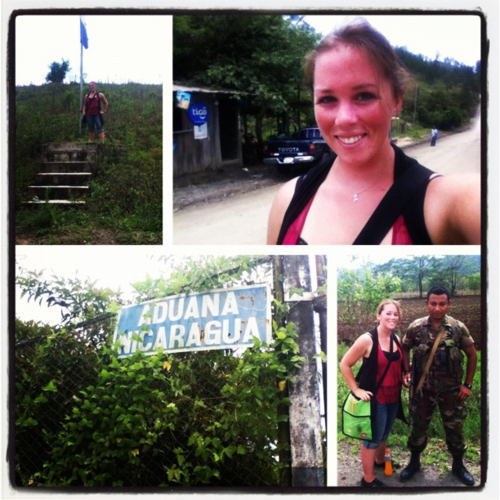
city of Jalapa), we hopped on a bus to the last community before the Honduran
border, Porvenir. We got to hang out with border patrol and put our toes in
Honduras before we walked into the community to do more house calls with blood
pressure and eye exams.
Look at the size of that ANT!
It was a LONG day, but ISLA hosted me and my site mate for
dinner that night at El Pantano, and it was very delicious! I’m not sure if my
site mate would be comfortable with me releasing his name, so from here on out,
his name shall be SM. The two of us walked back, at night, to our houses; but
if he weren’t there I would have taken a taxi because it was: A. DARK, B.
raining a little, and C. I don’t go anywhere alone at night.
Wednesday
Another full day! In the morning, I took some of the students and
the CJ professor to the Police Station where the chief of police took us on a
tour of the station. Apparently, the police have 1-week shifts where they are
on-call the entire week; they only receive C$12 per day for food, have maybe
4-6 beds to sleep on, only one toilet to share (I feel for the two female
cops), 2 showers and only ONE patrol vehicle to use; they usually have a motorcycle,
too, but it is out of commission at the moment. The chief also showed us the
jail, inside the station, where there were actual detainees. The cells could not
have been more than 10x10 feet (10 square feet?) and there were up to 4 guys in
a cell. The chief told me that until this past Sunday there were 30
detainees/prisoners divided into the three cells. I’m glad that they are
putting people away, but for them to be in conditions like that? I felt bad for
them; they also do not receive food, they rely on their families and/or friends
to bring it to them and for those prisoners who don’t have anyone, the
prisoners with food share. They don’t even have a toilet or plumbing; they just
do their business in a tube.
After the police, I took a small group to see the Catholic Church on the way to
the library where they painted the auxiliary room that they use as a children’s
free area. I introduced myself to the librarians and they would like to
collaborate in the future as well. We then sat in on a reading time with some
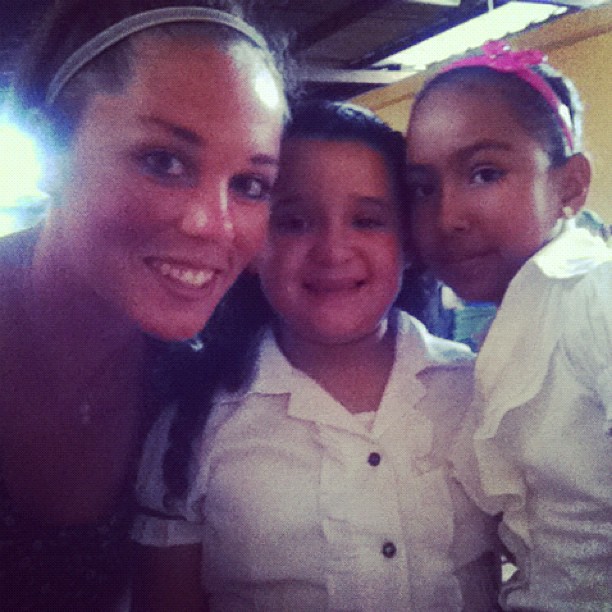
children from the elementary school, and some even did folkloric dances and poetry for us!
In the afternoon, people went to more barrios, had free time,
or went to the women’s center to do blood pressure and eye exams. I went to the
center to help with more interviews, and afterwards went with the group to meet
the people I work with at the Casa de Adolescencia. It sounds like ISLA may be
able to do some small fundraising for the organization, seeing as how their
main donors are cutting their funds this year.
Later in the evening, we had a nice farewell dinner at El
Pantano, a rousing game of Catch Phrase (in the dark! The electricity went
out!), and enjoyed each other’s company.
They were all trying to deload (or make more room for souvenirs) so I
obtained a “like-new” pair of Keen shoes, a wick-away shirt, some bug spray,
trail mix and Costco sized peanut butter. SCORE! They left this morning to
Matagalpa and Granada before and head back to the states on Sunday.
I had a great week with the group. Not only did I learn
about potential opportunities I have as a volunteer, but the opportunity to
work with them in the future and be a type of liaison between them and Jalapa
until they come back with a new group of students next May! I gained new
knowledge, new contacts and new friends and I can’t wait to meet future ISLA
groups!